
Montclair State University Growing Your Startup Company Consulting Project (Spring 2027)
| Program Overview | ||
|---|---|---|
| Program Title | Montclair State University Growing Your Startup Company Consulting Project (Spring 2027) | |
| Organization | Montclair State University | |
| # of Students Enrolled |
0
|
|
| # of Projects Running |
0 Project/s Added (of 1 Project Expected)
|
|
|
Program Timeline Project Duration |
Start Date: 03/15/27 End Date: 05/03/27 2 months |
|
| Collaboration Overview | ||
|---|---|---|
| About Students |
Students participating in this program are senior undergraduate business students specializing in Entrepreneurship at Montclair State University's Feliciano School of Business. Students have completed prerequisite business coursework and enter the capstone with foundational preparation in areas including entrepreneurship, business strategy, finance, marketing, and operations. During the first half of the semester, students study entrepreneurial companies and examine how businesses evolve as they move through growth stages. They then apply that knowledge to the live client engagement during the second half of the semester. Students are prepared to examine an entrepreneurial company holistically rather than from only one functional perspective. Depending on the project, they may analyze customer acquisition, market opportunity, business models, revenue streams, competition, positioning, operations, partnerships, organizational requirements, financing, and financial performance. A particularly important component of the course is developing students' ability to connect strategy with financial implications. Using LivePlan, students learn to translate growth assumptions and operating decisions into integrated financial forecasts and use those forecasts to evaluate whether a proposed business model is economically viable.
Student Level: Bachelor Degree Student Time Commitment: Full Time Team Structure: 3 - 6 |
|
| Program Goals | Through the Startup Growth Strategy & Business Model Consulting Project, students will:
|
|
| Format Structure |
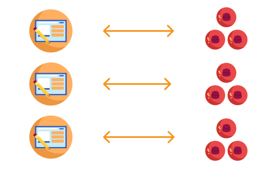
Multiple Projects Multiple Teams |
|
| Format Title | Startup Growth Strategy & Business Model Consulting | |
| Format Description | The Montclair State University Entrepreneurship Capstone Consulting Project connects senior undergraduate Entrepreneurship students with a growth-stage startup, emerging company, or small business seeking strategic support as it moves beyond initial launch and into its next stage of growth. During an intensive 7-week consulting sprint, student teams work with one participating organization to analyze its growth strategy, business model, competitive positioning, customer acquisition approach, revenue model, financial outlook, and investor readiness. The organization serves as the shared client for the class, while individual student teams may explore different strategic priorities, markets, customer segments, revenue models, or growth opportunities. Students enter the engagement after spending the first half of the semester studying how entrepreneurial companies grow and applying relevant business and entrepreneurship frameworks. The live project then allows them to use those concepts in a real organizational setting. Ethne specifically structures the course around one company, with multiple student teams taking different perspectives on the same overall growth challenge. Strong partners should already have a validated product or service, with evidence such as active users, pilot customers, testbeds, initial sales, or early revenue. This is not primarily an idea-validation exercise. Students are most valuable when the founder has moved beyond initial concept development and is confronting real decisions about how to grow, monetize, differentiate, finance, and operate the business. Depending on the company's needs, student teams may explore:
Using LivePlan, students develop an integrated strategic business plan and, where sufficient company information is available, build a three-year financial model that connects strategic decisions with projected income statements, balance sheets, cash flow, and unit economics. Teams also develop presentation materials designed to communicate their analysis and recommendations clearly to founders, investors, accelerators, or strategic stakeholders. The engagement culminates in a founder-facing presentation and handoff of the students' strategic work. The goal is to provide the participating company with thoughtful outside analysis and actionable growth recommendations while giving students substantial, resume-ready experience advising a real entrepreneurial organization. |
|
| Benefits For Industry Partners | Participating founders gain a concentrated strategic consulting engagement with senior Entrepreneurship students focused on helping the organization think critically about its next stage of growth.
Growth Strategy Analysis Students can examine customer acquisition, expansion opportunities, revenue models, partnerships, pricing, market positioning, and other strategic questions that directly affect the company's ability to scale.
Multiple Strategic Perspectives Rather than receiving the perspective of only one team, the participating company can benefit from multiple student teams exploring different aspects of the same organization or growth challenge.
Business Model Development Students can evaluate the company's existing model and propose refinements to customer segments, value propositions, channels, partnerships, revenue streams, and other core components.
Competitive & Market Insight Teams can map relevant competitors, benchmark alternative approaches, identify strategic gaps, and help clarify how the organization can establish a stronger differentiated position.
Financial Modeling Where sufficient information is available, students will translate strategic assumptions into a three-year integrated financial forecast, including income statement, balance sheet, cash flow, and unit economics modeling using LivePlan.
Investor Readiness Students can help founders strengthen the strategic and financial story presented to investors, accelerators, lenders, or strategic partners and develop a polished presentation deck.
Substantial Outside Perspective with Limited Founder Burden The project is deliberately structured around a small number of meaningful founder touchpoints rather than requiring constant supervision.
|
|
| Project Modality | Fully Remote | |
| Industry Partner Requirements to Participate | ||
|---|---|---|
| Project Topics | Growth Strategy Innovation Marketing Operations Product Design & Development Reporting, Financial Planning & Analysis Research, Analysis, Evaluation Sales & Business Development Strategic Planning | |
| Target Industries | Aerospace & Defense Agriculture & Farming Arts & Recreation Biotech & Pharmaceuticals Computers & Hardware Construction, Repair & Maitenance Consulting & Professional Services Consumer Products & Services Education & Ed-Tech Energy & Utilities Fashion & Apparel Finance & Investment Food & Beverage Government Health Care & Life Sciences Insurance Manufacturing & Industrial Media, Publishing & Content Natural Resources Non-Profit & Social Impact Public Works Real Estate Restaurants, Bars & Food Services Retail & E-Commerce Semiconductor Software, AI & Data Sports & Entertainment Sustainability & Climate Telecommunications Transportation & Logistics Travel & Tourism | |
| Skills & Expertise | B2B Growth Strategy B2B Sales Strategy B2C Growth Strategy Business Analysis Business Model Analysis Business Model Canvas Business Model Design Business Model Innovation Business Planning Business Presentations Cash Flow Forecasting Client Communication Competitive Analysis Competitive Benchmarking Competitive Positioning Consulting Consumer Acquisition Strategy Customer Acquisition Customer Discovery Customer Persona Development Customer Segmentation Customer Value Proposition Executive Presentations Financial Analysis Financial Forecasting Financial Modeling Financing Strategy Go-to-Market Strategy Growth Strategy Industry Analysis Investor Readiness LivePlan Market Analysis Market Entry Strategy Market Research Market Segmentation Market Sizing Marketing Strategy Monetization Strategy Operational Planning Partnership Strategy Pitch Deck Development Pricing Strategy Product-Market Fit Analysis Professional Communication Revenue Forecasting Revenue Model Design Sales Funnel Development Sales Strategy Scenario Analysis Startup Strategy Strategic Analysis Strategic Planning Subscription Pricing Target Market Analysis Team Collaboration Three-Year Financial Forecasting Unit Economics Value Proposition Design | |
| Location Information & Preferences |
Located Anywhere Strong startup and growth-stage partners may be located anywhere as long as they can participate effectively through virtual collaboration. Preference may be given to New Jersey, New York City, and broader Northeast-region companies when geographic proximity creates meaningful opportunities for students to meet founders, visit the organization, or participate in an in-person final presentation. Project quality, company traction, founder engagement, and fit with the course learning objectives are more important than geography.
|
|
| Sponsorship |
Sponsorship Requested (Optional):Pre-Revenue Startup an exact contribution amount of $500.0 Growth Startup an exact contribution amount of $500.0 Small to Medium Business an exact contribution amount of $500.0 Large Enterprise an exact contribution amount of $500.0 Government Organization an exact contribution amount of $500.0 Non-Profit an exact contribution amount of $500.0 |
|
| Compensation |
No Compensation Required |
|
| Other Requirements | The strongest partners will be growth-stage startups, venture-backed companies, emerging businesses, or established small businesses that have moved beyond the idea stage and now face substantive decisions about how to grow. Ideal participating organizations should:
The exact project scope will be agreed upon by the faculty member and participating founder before students begin active project work. Students may complete appropriate NDAs provided by the company or instructor. Operational information and financial metrics shared for the project will be used for educational and project-development purposes within the course. |
|
| Expected Time Commitment For Project Managers | 1 Hour per week | |
| Key Program Dates | Due Date |
|---|---|
|
Request for Proposal published
Collaboration request published. Industry Partners may express interest in participating.
|
Sep 22 2026, 09:02 PM UTC |
|
Interview
Educators will begin interviewing interested Industry Partners to discuss project ideas.
|
Oct 09 2026, 09:02 PM UTC |
|
Proposal Application Deadline
Final date for Industry Partners to express interest in participating.
|
Jan 21 2027, 09:02 PM UTC |
|
Finalize Project Charter
Educators and Industry Partners finalize project charters, legal documents, and background materials.
|
Feb 08 2027, 09:02 PM UTC |
|
Official Program Launch
We’ll find a time on this day for you to meet with the students to kick off your project.
|
Mar 15 2027 |
|
Official Program End
We’ll find a time on this day for you to meet with the students to wrap up your project.
|
May 03 2027 |
Program Timeline
|
Due Date
|
Activities |
Deliverables
|
Status
|
Action | |
|---|---|---|---|---|---|
|
Mon, 03/15/27
|
Program Kickoff
|
No Deliverables
No deliverables are required for this action item.
|
|||
|
Location:
|
|||||
Projects
| Project | Organization | Topics |
|---|
Program Managers
| Name | Organization |
|---|---|
| Ethne Swartz | Montclair State University |
Teams
| Team Name | Project Name | Team Members |
|---|---|---|
| No Teams Available |